Adela’s possible pregnancy
The House of Bernarda AlbaAdela’s possible pregnancy is an inference built from the play’s clues rather than a confirmed fact. The commentary links her distress and likely nighttime meetings with Pepe el Romano to the possibility that she is experiencing early pregnancy, then points to her gesture of clutching her stomach during the villagers’ pursuit of an unmarried mother. Because the play leaves the matter unresolved, the possibility works as a pressure point between private desire, public punishment, and the family’s effort to preserve its reputation.
Clues and Uncertainty
The commentary on Adela’s illness describes her as devastated by the news that Pepe el Romano is to marry Angustias. It interprets her sickness as emotional, while allowing that she may also be experiencing early symptoms of pregnancy. The wording remains cautious: this is a plausible reading of her condition, not a diagnosis established by the action.
The timing offers context for that reading. The commentary notes that enough time has passed between the first and second acts for Adela to have begun meeting Pepe in secret, and that she may have been seeing him even earlier. It also points to signs that she leaves the house at night. These circumstances connect the possibility of pregnancy to the concealed relationship, while leaving both its precise duration and its physical consequences uncertain.
The Unmarried Mother and Adela’s Gesture
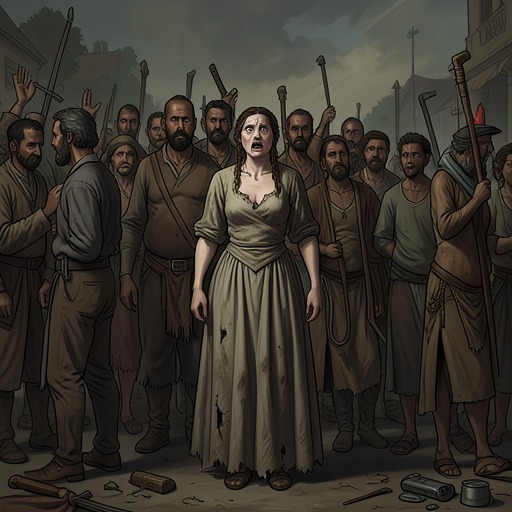
In the second act’s account of Librada’s daughter, Poncia tells the household that the unmarried woman gave birth to a child, concealed the birth, and that dogs exposed what had been hidden. Villagers are pursuing her, and Bernarda endorses their intention to kill her. Adela objects to the proposed killing. The scene sets an immediate contrast between the crowd’s demand for punishment and Adela’s refusal to accept it.
At the close of the scene, Adela clutches her stomach as she cries out against the violence. The accompanying commentary reads this stage direction as seeming to confirm the earlier indications that she may be pregnant. It strengthens the possibility without settling it: the gesture is suggestive, but the play does not explicitly state that Adela is carrying a child.
Sexual Honour and Social Punishment
The episode makes the potential consequences of pregnancy legible through the village’s response to Librada’s daughter. Her motherhood outside marriage becomes a public scandal, and the pursuit turns social condemnation into threatened mob violence. The commentary situates this response within a broader sexual double standard: women’s sexual conduct is judged through chastity and family reputation, while men’s sexual freedom is more readily accepted.
That social order is also visible in Bernarda’s conduct. She insists that the villagers be told Adela died a virgin and orders the household to maintain that account. Her statement does not prove or disprove a pregnancy; it demonstrates that, after Adela’s death, protecting the family’s public honour takes priority over acknowledging an uncertain private reality. The possibility of pregnancy thus belongs to the play’s conflict between women’s lives and the reputational rules imposed upon them.
Narrative and Dramatic Significance
The uncertainty is central to the effect of the pregnancy clues. The play does not resolve them through a declaration or a plot disclosure; instead, it places suggestive circumstances beside an episode of public persecution and an act of concealment. Readers can recognize the stakes of Adela’s possible condition without treating it as established fact.
The play was completed in June 1936, amid growing political unrest in Spain. Its author described it as a photographic documentary and presented it as a drama of women in Spanish villages; the commentary likewise connects its realism to contemporary provincial life. In that frame, Adela’s possible pregnancy is not an isolated medical question. It intensifies the work’s portrayal of how gendered sexual codes and concern for reputation can make private circumstances vulnerable to public judgment, while Bernarda’s final insistence on silence attempts to close off the truth rather than clarify it.